Instagram Didn’t Create Perimenopause — It Created Awareness
And honestly?
It’s about time. Because for years, women have been walking around exhausted, anxious, wired-but tired, gaining weight around the middle, sleeping badly, snapping at people they love, forgetting words mid-sentence, losing motivation, feeling disconnected from themselves, and wondering what on earth happened.
And far too often, they were told it was stress. Or age. Or being busy. Or “just hormones.” Or my personal favourite: “That’s just part of being a woman.”
No. Let’s not do that anymore.
For our mothers and grandmothers, the story was often very different. Many of them just got on with it because that was what they were expected to do.
They pushed through.
They kept the house running.
They raised the children.
They worked.
They cared for everyone else.
They didn’t have the language, the support, or the permission to say, “Actually, something feels really off here.” Symptoms were brushed aside as being emotional, dramatic, tired, stressed, ageing, or simply not coping well enough. And because no one was talking about it properly, many women thought they were the only ones.
That silence did a lot of damage.
Now, things are changing. Women today are asking different questions. We Google things at 11pm. We listen to podcasts while driving. We follow experts. We read captions. We compare notes with friends. We send reels to each other with the message, “Is this me?” We are joining the dots in a way previous generations often weren’t able to.
And yes, for many women, the first time they hear someone describe what they are experiencing is not in a doctor’s office. It’s on Instagram. A 30-second reel might be the first time a woman hears someone say, “Brain fog can be hormonal.” Or, “That sudden anxiety you’ve never had before? It could be perimenopause.” Or, “Poor sleep, rage, weight gain around the middle, exhaustion, inflammation, low mood, loss of motivation, and feeling like you’ve lost yourself can all be part of the picture.” And suddenly she thinks: “Hang on. That’s happening to me too.”
That moment matters. Not because Instagram is diagnosing her. It isn’t. And it shouldn’t.
Social media is not a replacement for proper healthcare, testing, treatment, coaching, or professional support. Let’s be very clear on that.
But what social media can do is give women language. It can help a woman walk into an appointment and say, “I think this might be hormonal,” instead of sitting there feeling embarrassed, confused, or like she’s making a fuss. It can help her stop blaming herself for not being disciplined enough, patient enough, calm enough, energetic enough, or motivated enough.
It can help her realise she is not broken. She is not lazy. She is not going mad. Her body is changing, and she deserves to understand what is happening.
I know this personally. I was diagnosed with perimenopause at 37. And I’ll be honest with you — I thought I was too young. For about six months before I got answers, I genuinely felt like I was going insane. I knew something wasn’t right, but I couldn’t make sense of it. I was in the health and fitness industry. I knew bodies. I knew training. I knew nutrition. I knew stress mattered. I knew sleep mattered.
But this felt different.
And that is the part so many women struggle to explain. You can be doing “all the right things” and still feel completely unlike yourself. You can be eating well, training, working hard, showing up for your family, doing your job, trying to stay positive — and still feel like someone has quietly taken the old you and replaced her with a version you don’t recognise.
That is frightening. And when you are told it is just stress, or just ageing, or just life, it can make you question yourself even more.
This is why the conversation matters. Because the women in their late 30s, 40s and 50s right now are not a generation that has had the luxury of falling apart. We are the generation that has had to figure things out.
We have built careers.
Raised children.
Supported partners.
Managed households.
Cared for ageing parents.
Paid bills.
Made appointments.
Remembered everyone’s school events, dentist check-ups, passwords, food preferences, emotional needs, and where the clean socks are.
We have held a lot together. So when something feels off, we don’t just accept, “Well, this is your life now.” We research. We learn. We ask questions. We seek solutions. Not because we are difficult. Not because we are dramatic. Not because we want to be labelled with something.
But because we have spent our whole lives adapting, solving problems, and carrying on — and at some point, carrying on without answers is not good enough.
That is the real reason everyone is suddenly talking about perimenopause. It is not because it is trendy. It is not because women are looking for excuses. It is not because Instagram invented a new problem.
It is because women are finally saying, “I am not willing to feel exhausted, overwhelmed, anxious, inflamed, disconnected, and unlike myself and be told that is simply the price of getting older.”
And honestly, good.
Because ageing is a privilege, yes. But suffering in silence is not a requirement. Perimenopause can affect your sleep, mood, body composition, training recovery, appetite, confidence, patience, libido, motivation, mental clarity, and your relationship with yourself.
It can be subtle at first. It can come in waves. It can look different for every woman. And that is exactly why awareness matters. When you understand what is happening, you can respond differently.
You can stop punishing your body and start supporting it.
You can stop chasing the old plan that no longer works and start building one that meets you where you are now. You can look at nutrition, strength training, stress, sleep, hormones, boundaries, blood work, recovery, and support with a clearer head. You can stop making it a character flaw and start treating it like a real life stage that deserves real attention.
Because that is what this is. Perimenopause is not some made-up social media buzzword. It is a biological transition that half the population will move through in some way, and yet for far too long, women were expected to stumble through it quietly while still functioning at full capacity.
No wonder so many of us are angry. No wonder so many of us are tired. No wonder so many of us are relieved when someone finally says the thing out loud. This conversation is not about making women fear their bodies. It is about helping women understand their bodies. It is about saying, “You are not alone, and you are not imagining this.” It is about giving women the confidence to seek proper support, ask better questions, and make changes that actually fit this season of life.
So if you have been wondering why perimenopause is suddenly everywhere, here is my take: It was always here. Women were always experiencing it. They just weren’t always being heard. Now we are talking. We are comparing notes. We are calling out the vague answers. We are refusing to be fobbed off. We are learning what our mothers and grandmothers were never properly taught. We are getting stronger, clearer, and a lot less willing to shrink ourselves to make other people comfortable.
And if that makes this conversation feel loud? Good. Maybe it needs to be.
If this made you think, “This is me,” then please don’t ignore that. You do not have to panic, and you do not have to overhaul your entire life by Monday morning. But you do deserve to understand what is happening and what your next best step could be. If you would like support with your nutrition, strength, balance, and understanding what your body needs in this phase, you can book a clarity call with me and we can talk it through properly.
P.S. You are not broken. You are not past it. You are not being dramatic. But you may need a different approach now — and that is not failure. That is wisdom.
Why that weekend sleep-in isn’t fixing your exhaustion
Hey babe,
You’re exhausted. You’re snapping at your kids, your partner, or your team at work. You’re forgetting words mid-sentence, and no amount of coffee is fixing that deep, bone-tired feeling. Everyone tells you you’re just “doing too much.” You’re a busy woman, probably juggling a career, a family, and a never-ending to-do list. So, you assume it’s burnout.
But what if it’s not? What if your body isn’t just tired—what if it’s begging for a structural change? I see this all the time. Women come to me thinking they just need a holiday, when in reality, their hormones are shifting.
I’ve been in the health and fitness industry for over 15 years, and I was diagnosed with perimenopause at 37. I know exactly what it feels like when your body stops playing by the old rules, and I’m not going to sugarcoat it for you.
Let’s get straight to it.
The symptoms of burnout and perimenopause look incredibly similar: the fatigue, the brain fog, the mood swings, the feeling like you’re constantly running on empty. But they are fundamentally different beasts.
Burnout vs. Perimenopause: How to tell the difference
The “Rest” Test: If it’s burnout, a proper break—a real holiday where you actually switch off—will usually help you bounce back. If it’s perimenopause, you could sleep for a week on a beach in Fiji and still wake up feeling like you’ve been hit by a bus.
The Physical Shifts: Burnout is mostly mental and emotional exhaustion. Perimenopause brings uninvited physical guests: your periods might get weird, your joints might ache for no reason, and you might start waking up at 3 AM drenched in sweat.
The “Why Now?” Factor: Burnout usually has a clear trigger—a massive project at work, a stressful life event. Perimenopause can sneak up on you when everything else in your life is actually going fine. Here’s the truth: Burnout is exhaustion.
Perimenopause is your body demanding a completely new operating system. You can’t just push through it, and you can’t outhustle it.
So, what do we do?
We go back to basics. No complicated protocols, no BS.
Just the four foundations that actually move the needle:
1. Sleep Stop the revenge-bedtime procrastination. Your body does its heavy lifting and repair work while you sleep. Tip: Set a hard cut-off time for screens. If you’re waking up at 3 AM, keep your room cool and look into a high-quality magnesium supplement before bed.
2. Stress Management You can’t eliminate stress, but you can change how your body handles it. Tip: Find 10 minutes a day to do absolutely nothing. Not scrolling, not planning dinner. Just breathe. Tell your nervous system it’s safe.
3. Real Food Your changing hormones need building blocks, not sugar crashes. Tip: Prioritise protein at every single meal. It keeps your blood sugar stable and stops those 3 PM sugar cravings dead in their tracks.
4. Movement The days of punishing yourself with endless cardio are over. Your body needs strength and balance now. Tip: Start lifting heavy things. Even if it’s just bodyweight squats or dumbbells in your living room twice a week. Build the muscle; protect your bones.
You don’t have to figure this out alone, and you definitely don’t have to just “put up with it.”
If you’re reading this and thinking, “Holy shit, she’s talking about me,” let’s chat.
Book a discovery call.
Let’s get you feeling like yourself again.
If you have a friend or colleague who is constantly complaining about being “burnt out” but you suspect there’s more to the story, forward this to her.
We need to stop normalising feeling like crap in our 40s.
Drowning in the Sea of "Healthy"
Drowning in the Sea of "Healthy": Why It’s Easier to Give Up (And How to Stop)
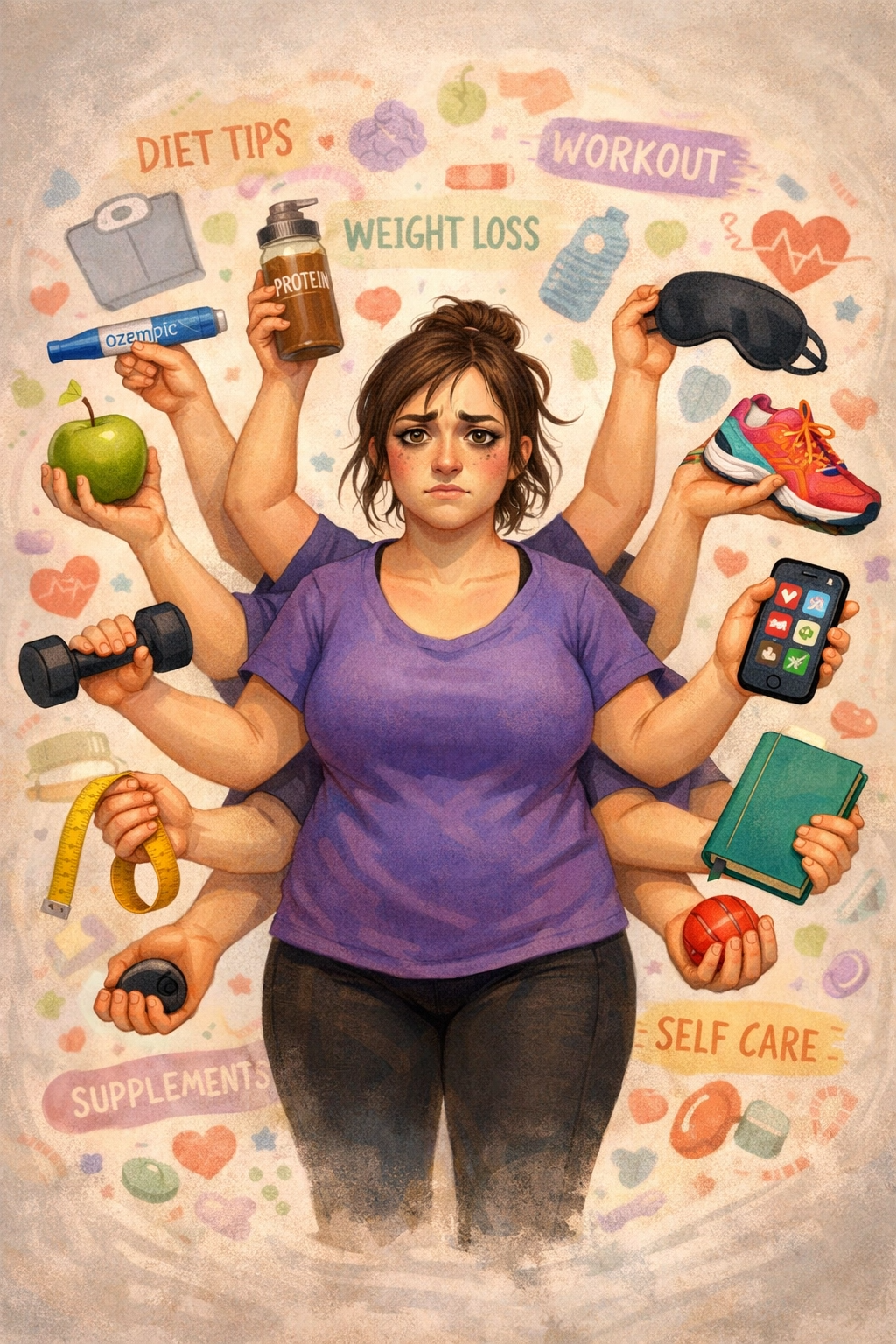
We’ve all been there. You wake up on a Monday morning, determined that this is the week everything changes. But then, the noise starts. An ad for a new "miracle" injection, a friend swearing by a specific protein shake, an influencer dictating your workout. Suddenly, you’re holding ten different health items, exhausted before you’ve even taken a single step.
This image perfectly captures how many of us feel when trying to get healthy. The sheer volume of well-meaning advice makes us feel like we’re drowning. It’s why so many people give up—not from lack of willpower, but from overwhelm.
But here’s the truth: It doesn’t have to be this way. As your coach, my job is to take those ten heavy items out of your hands and give you back just one thing: Clarity. Discover how to cut through the noise and build a sustainable health journey, one foundational step at a time.
Why It’s Easier to Give Up (And How to Stop)
We’ve all been there. You wake up on a Monday morning, determined that this is the week everything changes. You’re going to eat better, move more, sleep longer, and finally "get healthy."
But then, the noise starts.
You open your phone and see an ad for a new "miracle" injection. Your best friend swears by a specific protein shake. A fitness influencer tells you that if you aren’t hitting 15,000 steps and lifting heavy five days a week, you’re wasting your time. Someone else insists that blue light is the enemy and you need a $100 eye mask, while another person says it’s all about "gut health" and a dozen different supplements.
Suddenly, you’re the woman in the image above. You have ten hands, and every single one of them is full. You’re holding the Ozempic, the apple, the dumbbell, the measuring tape, the diary, the stress ball... and you’re exhausted before you’ve even taken a single step.
The Sea of Information Overload
There is a massive "sea of information" out there. Most of it comes from people who mean well, but the sheer volume of it makes us feel like we’re drowning. When every "expert" has a different "must-do" tip, the weight of all those expectations becomes too heavy to carry.
This is why so many people give up.
It’s not because they lack willpower. It’s because they are overwhelmed. When the path to health looks like a chaotic, never-ending to-do list, it feels easier to just stay where you are. At least where you are is familiar.
But here’s the truth: It doesn’t have to be this way.
Cutting Through the Noise: The Health Pyramid
As your coach, my job is to take those ten heavy items out of your hands and give you back just one thing: Clarity.
We don’t need to do everything at once. In fact, we shouldn’t. To build a health journey that actually lasts, we need to follow a structure. Think of it like a pyramid—you can’t build the top until you’ve secured the base.
Level 1: The Foundation (The Most Important Part)
This is where it all starts: Radical honesty. You can’t skip this. Before you buy the shoes or the shakes, you have to decide why you want to change. Not just "to lose weight," but the deep reason. Is it for more confidence? Because you’re sick of being tired? Write it down. This is what keeps you going when motivation inevitably fades.
Level 2: Guidance & Structure
Stop guessing and start executing. This is where a plan comes in—meal plans, workout schedules, and real accountability. Whether it’s a coach in your corner or a non-negotiable diary entry, winging it is not a strategy.
Level 3: Nutrition Fundamentals
Fat loss happens here, but it doesn’t have to be complicated. Understand the basics: Calories change your weight, Macros shape your body, and Micros impact your mood. If you have a coach, ask questions and learn. If not, take responsibility for understanding what goes on your plate.
Level 4: Movement & Output
We aren’t just trying to "shrink" your body; we’re building it. Start simple with steps to build consistency, then move into strength training. We’re chasing muscle because muscle equals a higher metabolism, more strength, and a better shape. We aren’t chasing "skinny"—we’re building strong.
Level 5: Optimisation (The Least Important Part)
This is the 5% that people often mistake for the 95%. Supplements, meal timing, fat burners—they can help, but only after everything else is in place. Most people start here and stay stuck because their foundation is missing.
Let’s Make It Easier
If you’re feeling like the woman in the illustration—tired, frustrated, and overwhelmed—take a deep breath. You don’t need to hold all those things at once.
My mission at Coach Joelene is to help you put down the "extras" and focus on the essentials. We’ll build your pyramid from the bottom up, one solid step at a time.
Which level are you actually working on right now? Are you building your foundation, or are you stuck at the top chasing quick fixes?
Let’s stop the drowning and start the doing.
Ready to simplify your journey? Click the link in my bio to learn more about how we can build your foundation together.